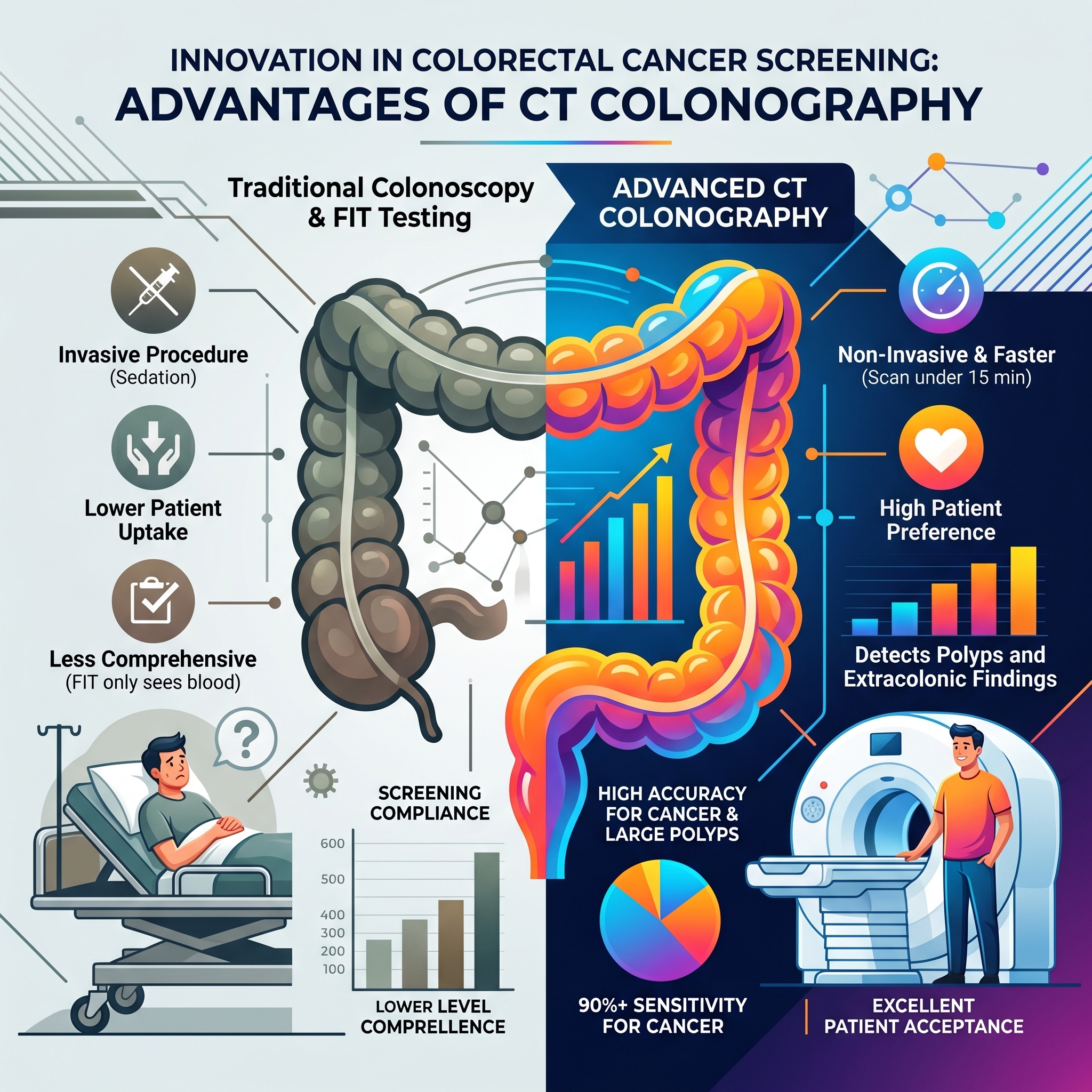
The Radiological Society of North America (RSNA) doesn't mince words in its latest assessment of colorectal cancer screening: CT colonography (CTC) is a better alternative to FIT testing and a reliable alternative to traditional colonoscopy.
That's not a fringe opinion. That's the world's largest radiology organization — with over 54,000 members — putting its credibility behind a technology that, for too long, has been treated as the backup option rather than the smart first choice.
What the RSNA Is Actually Saying
The RSNA's framing is significant. They aren't describing CT colonography as an acceptable fallback for patients who refuse traditional colonoscopy. They're positioning it as a better alternative to FIT — one of the most commonly used stool-based screening methods — and a reliable alternative to colonoscopy itself.
That distinction matters enormously in clinical practice, where stool-based tests like FIT (fecal immunochemical test) are often offered as the path of least resistance. They're easy to administer, require no preparation, and patients can do them at home. But ease of use isn't the same as clinical effectiveness.
Stool-based tests have well-documented limitations: they have relatively low sensitivity for detecting precancerous polyps, carry meaningful false-positive rates that send patients through unnecessary follow-up procedures, and require annual or biennial retesting to maintain any meaningful level of protection. A positive FIT result still requires a follow-up colonoscopy — meaning patients who screen positive have done two procedures where one might have sufficed.
Why This Matters Beyond the Radiology Community
The RSNA's endorsement isn't just a win for radiologists. It's a signal to primary care physicians, gastroenterologists, and health systems that the evidence base for CT colonography has matured to the point where it should be a front-line conversation — not an afterthought.
Colorectal cancer remains the second leading cause of cancer death in the United States, and screening rates remain stubbornly low. A significant driver of non-compliance isn't ignorance — it's avoidance. Patients skip colonoscopies because they require sedation, bowel prep, time off work, and someone to drive them home. These aren't small inconveniences. For many people, especially those without flexible schedules, reliable transportation, or a support system, they're genuine barriers.
When the most commonly offered alternative is an annual stool test with limited sensitivity for the very polyps screening is meant to catch, patients are left choosing between a procedure they dread and a test that may not give them adequate peace of mind.
The Case for CT Colonography, in Plain Terms
CT colonography uses low-dose CT imaging to produce detailed, three-dimensional images of the colon — without sedation, without a scope, and typically without the recovery time associated with traditional colonoscopy. It can detect polyps with high accuracy, and it has an additional advantage colonoscopy doesn't offer: the ability to identify extracolonic findings — incidental discoveries outside the colon, such as aortic aneurysms, kidney masses, or other abnormalities that might otherwise go undetected.
The RSNA's characterization of CTC as a reliable alternative to colonoscopy aligns with years of published research and guidelines from multiple major medical organizations, including the American Cancer Society and the U.S. Multi-Society Task Force on Colorectal Cancer, which have included CTC among recommended screening options for average-risk adults.
The key word in the RSNA's framing is reliable — not merely acceptable, not simply tolerated. Reliable.
The Screening Gap Is a Solvable Problem
There's a frustrating irony at the center of colorectal cancer prevention: we have effective screening tools, and yet millions of eligible Americans still aren't screened. Some estimates suggest that roughly one in three adults between 45 and 75 is not up to date on colorectal cancer screening.
Part of the solution is expanding the menu of options patients are actually offered — not just in name, but with genuine clinical endorsement and accessible pathways to follow through. When patients hear that CT colonography is validated by a body like the RSNA as better than FIT and comparable to colonoscopy, that changes the conversation in the exam room.
Where ColoWatch Fits In
At ColoWatch, we've built our model around exactly this premise: that CT colonography deserves to be a mainstream, accessible screening option — not a specialty procedure reserved for patients who've already been through the system. Virtual colonoscopy is non-invasive, requires no sedation, and can be scheduled and completed far more easily than traditional colonoscopy for many patients.
The RSNA's findings reinforce what we see every day: patients who would have otherwise skipped screening altogether are willing to engage when they're offered a high-quality, non-invasive alternative. Catching a precancerous polyp before it becomes cancer isn't just a clinical win — it's a life unchanged by a diagnosis that could have been prevented.
If you've been putting off colorectal cancer screening — or if you've recommended it to patients who keep finding reasons to delay — the evidence is clear. There's now a better option on the table, and a major radiology authority has said so.
Talk to your doctor about CT colonography, or visit ColoWatch to learn whether virtual colonoscopy is right for you.