Here's a number that should stop you cold: virtual colonoscopy has a utilization rate of just 2.2% among colorectal cancer screening methods in the United States — despite decades of evidence supporting its effectiveness.
That stat comes from a 2024 study highlighted in a recent Health City feature on Dr. Kevin Chang, a radiologist at Boston Medical Center and Chair of the American College of Radiology Colon Cancer Committee. Dr. Chang has spent the better part of his career making the case for a screening tool that most Americans have never been offered — let alone heard of.
His message is blunt: "The science is there. Now it's about making sure patients and providers use it."
A Tool That Works — Just Not One That's Used
Colorectal cancer is one of the most preventable cancers we know of. When caught early, the survival rate is 90%. That figure isn't abstract — it represents hundreds of thousands of lives that hinge entirely on whether someone gets screened or doesn't.
And yet, according to the same 2024 study, 80% of screened adults between ages 50 and 75 chose traditional colonoscopy as their preferred method. Virtual colonoscopy — also called CT colonography — sits at the opposite end of the spectrum as the least commonly used option.
This isn't a story about a screening tool that doesn't work. Research has shown that virtual colonoscopies are highly effective at diagnosing colorectal cancer and detecting clinically relevant polyps. The problem, as Dr. Chang frames it, is awareness and adoption — not efficacy.
Why So Many Patients Skip Screening Altogether
To understand why virtual colonoscopy matters, it helps to understand what's driving people away from screening in the first place.
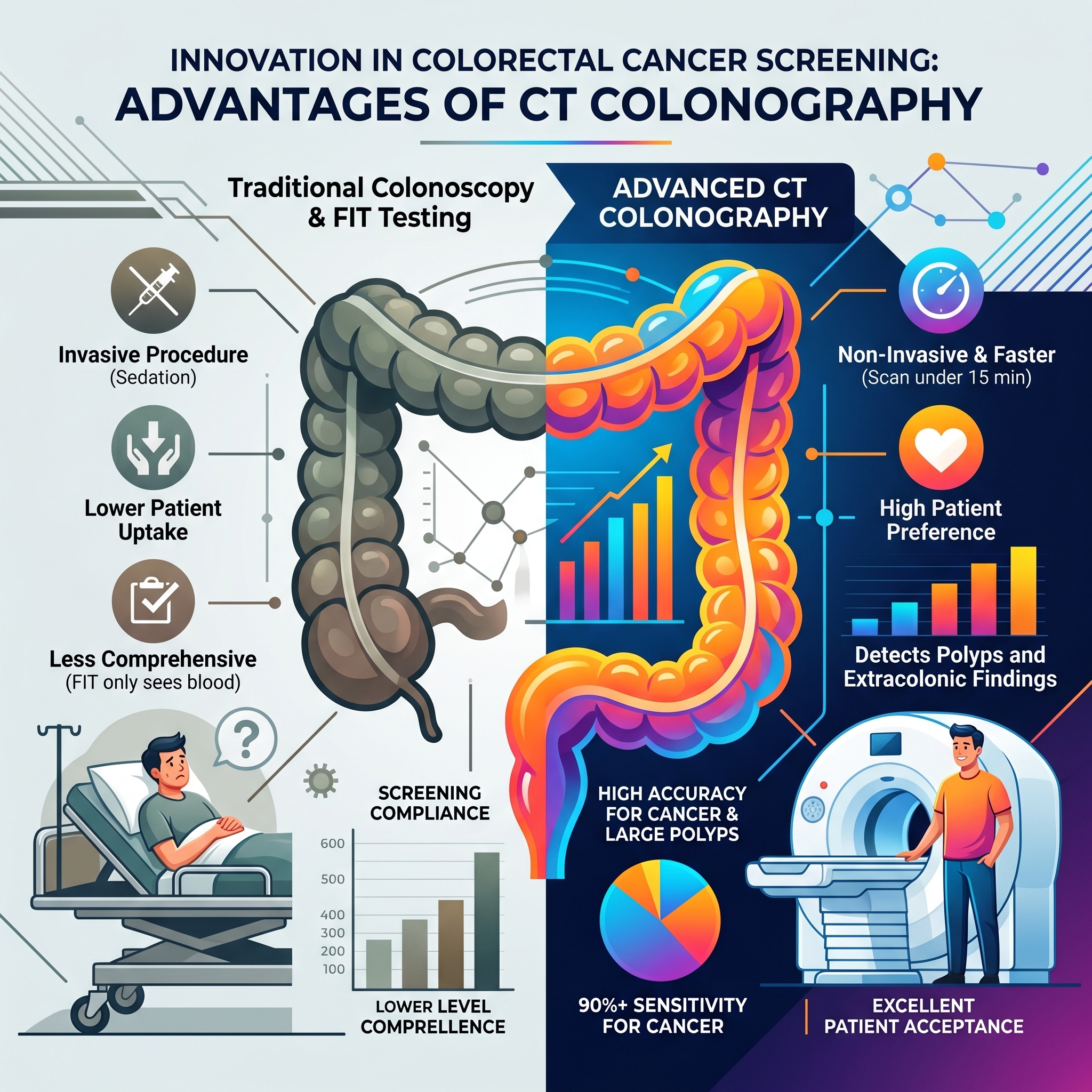
Traditional optical colonoscopy — the procedure most people picture when they hear "colonoscopy" — requires days of bowel preparation, dietary changes, sedation, and post-procedure transportation arrangements. It's an involved process, and for many people, that friction is a dealbreaker.
A 2025 study found that approximately half of patients who received a traditional colonoscopy reported procedure-related anxiety and emotional distress. That's not a minor inconvenience — that's a measurable barrier to care that keeps people from getting screened at all.
For patients who work hourly jobs, manage childcare, or lack reliable transportation, the ask of taking a full day off work and arranging a designated driver can tip the scales from "I'll schedule it" to "I'll put it off." And putting it off, in colorectal cancer, can be catastrophic.
What Virtual Colonoscopy Actually Offers
Virtual colonoscopy — introduced in 1994 and practiced at Boston Medical Center as early as 2001 — is a diagnostic imaging test, not a procedure. It uses CT scanning to produce a detailed view of the colon without sedation, without the need for a driver, and in as little as 10 to 20 minutes.
Patients can return to work immediately after. No sedation. No recovery period. No arranging someone to take you home.
"With the virtual colonoscopy you can go right back to work without having to acquire a driver," Dr. Chang explains, "which is huge for younger patients and working age patients. It's a big advantage to not have to take a day off from work."
This isn't just a convenience argument. For historically underserved communities — those with the least flexibility to navigate a complex healthcare system — these differences in accessibility are genuinely significant. Expanding what screening looks like expands who actually gets screened.
A Gateway, Not Just a Gate
One of the more compelling insights from Dr. Chang's work is how virtual colonoscopy functions not just as a standalone screening tool, but as a pathway deeper into care.
For patients who are hesitant about traditional colonoscopy, a virtual colonoscopy can serve as a lower-barrier first step. And when it detects something? The hesitation dissolves.
A trial published in The Lancet Gastroenterology & Hepatology found that 98% of patients with a positive virtual colonoscopy result went on to schedule and receive follow-up care. That is a remarkable conversion rate — and it underscores something important: people will act when they have clear information and a finding that motivates them.
"All of a sudden the hesitation for getting a traditional colonoscopy becomes nearly zero," Dr. Chang notes.
That's the real power here. Virtual colonoscopy isn't competing with traditional colonoscopy — in many cases, it's the step that gets patients there in the first place.
The Awareness Gap Is the Real Problem
Dr. Chang is candid about where the breakdown happens. "On the patient side, people are just not aware of the option. And those that are aware may not see it as a clinically sound method. On the provider side, despite the science, they are not offering it as a first-in-line option."
That's a two-sided problem — and it means the solution has to work on both fronts. Dr. Chang is doing his part: teaching other radiologists how to perform virtual colonoscopies at national conferences, authoring advocacy pieces in the American College of Radiology's publication Voice of Radiology, and publicly performing the test on himself to model transparency and patient trust.
His goal, simply stated: change the narrative around virtual colonoscopy from available to invaluable.
The Case for a Better Default
At ColoWatch, we've built our work around the same fundamental belief Dr. Chang articulates: screening only saves lives when people actually do it. A tool that patients avoid — however clinically excellent — isn't fulfilling its purpose.
Virtual colonoscopy (CT colonography) offers a path that is accurate, non-invasive, sedation-free, and designed for the real lives patients lead. It doesn't require you to take a day off work or find someone to drive you home. And critically, it detects polyps with high accuracy while also identifying findings beyond the colon that other screening methods miss entirely.
The 2.2% utilization figure isn't a reflection of virtual colonoscopy's value. It's a reflection of how little patients have been told it exists.
If you've been putting off colorectal cancer screening — or if your provider hasn't mentioned virtual colonoscopy as an option — it's worth asking. The science is there. Now it's about making sure you know it too.