ColoWatch® Co-Founder and President Dr. Mark Klein is featured in a new episode of AHRA’s Medical Imaging Matters podcast examining how virtual colonoscopy—also known as CT colonography—can expand access to colorectal cancer screening.
In the 53-minute conversation, AHRA Executive Director and podcast host Jason Newmark brings together two complementary clinical perspectives: Dr. Klein, a board-certified diagnostic radiologist who has performed more than 8,000 CT colonography screening studies, and Dr. Randall Pellish, a gastroenterologist at Lahey Hospital & Medical Center.
AHRA • Medical Imaging Matters
Virtual Colonoscopy: The Best-Kept Secret in Colon Cancer Screening
53:17 • Featuring Dr. Mark Klein and Dr. Randall Pellish
▶ Listen to the episode on AHRAWhy This Conversation Matters
Colorectal cancer screening is not a one-size-fits-all decision. Patients differ in their medical history, available time, access to transportation, tolerance for preparation, and comfort with sedation. The episode explores why meaningful screening access depends not only on having multiple tests listed in a guideline, but also on helping patients and referring providers understand how each pathway works.
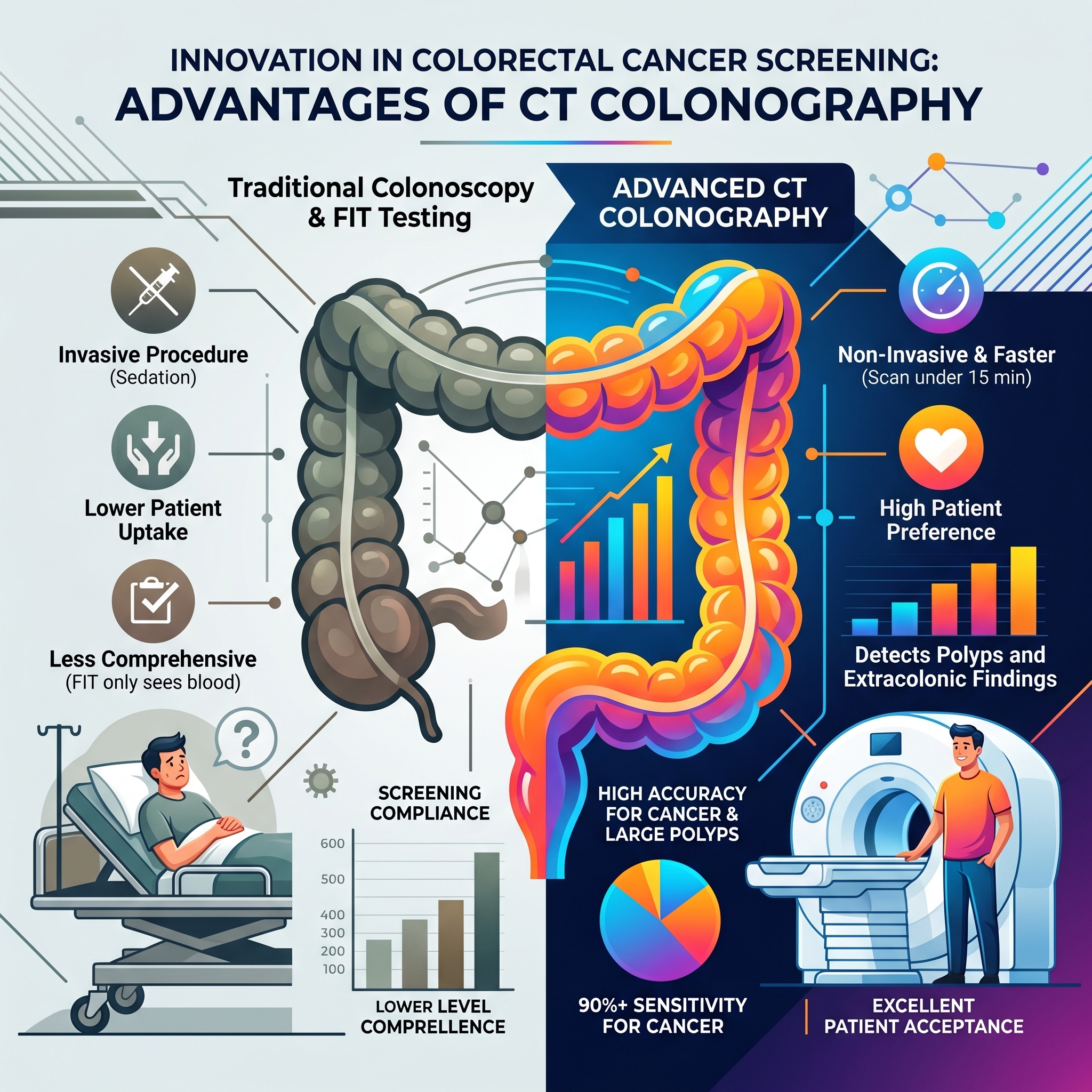
Virtual colonoscopy uses CT imaging to examine the colon without sedation. For many patients, that means no designated driver and no post-sedation recovery period. If an actionable polyp or mass is detected, the patient may still need an optical colonoscopy for removal or biopsy. Drs. Klein and Pellish discuss why coordinated radiology and gastroenterology pathways are essential to making that handoff timely and patient-centered.
Five Takeaways for Imaging and Healthcare Leaders
- Access starts with informed choice. Primary care teams need practical information about virtual colonoscopy, optical colonoscopy, and other screening options so they can help patients choose an appropriate test.
- Patient experience affects participation. A sedation-free option can reduce transportation, recovery, and time-away-from-work barriers for patients who might otherwise delay screening.
- Implementation requires more than a CT scanner. Consistent preparation instructions, acquisition protocols, technologist training, quality control, and experienced interpretation all contribute to a reliable program.
- Radiology and gastroenterology are complementary. Virtual colonoscopy can identify patients who need therapeutic follow-up, while optical colonoscopy remains necessary for polyp removal and biopsy.
- Specialized expertise can be extended. The discussion considers how standardized workflows and remote expert interpretation can help facilities offer CT colonography even when local reading capacity is constrained.
From Screening Test to Coordinated Care Pathway
One of the episode’s most constructive themes is collaboration rather than competition. The speakers discuss an ideal pathway in which a patient with a positive CT colonography result can move efficiently to a gastroenterologist—potentially the same day when local capacity and scheduling allow—without unnecessary delays or duplicated preparation.
That integrated model recognizes the strengths of both disciplines. Radiology can provide a minimally invasive screening pathway and scalable interpretation expertise; gastroenterology provides therapeutic intervention for the smaller group of patients whose findings require removal, biopsy, or further evaluation.
Building a Consistent Virtual Colonoscopy Program
For imaging leaders, the operational discussion is especially relevant. Adoption depends on more than adding a new exam to a scheduling menu. A dependable program needs standardized protocols, trained technologists, patient-centered preparation and communication, quality oversight, and access to radiologists with specific CT colonography experience.
ColoWatch® helps imaging facilities address those implementation requirements through a turnkey model that combines standardized acquisition workflows, training, quality controls, cloud-based case delivery, and interpretation by experienced radiologists.
About the Participants
- Dr. Mark Klein is Co-Founder and President of ColoWatch®. A board-certified diagnostic radiologist, he practiced in the Washington, D.C. area for more than 40 years and has performed more than 8,000 CT colonography screening studies.
- Dr. Randall S. Pellish is a gastroenterologist at Lahey Hospital & Medical Center and an Associate Professor of Medicine at UMass Chan-Lahey, UMass Chan Medical School.
- Jason Newmark is Executive Director of AHRA: The Association for Medical Imaging Management and host of Medical Imaging Matters.
Listen and Learn More
Listen through the official AHRA episode page, or follow Medical Imaging Matters on Spotify, Apple Podcasts, Amazon Music, or YouTube.
Interested in offering virtual colonoscopy at your imaging facility? Contact ColoWatch® to discuss program implementation, training, and interpretation support.
This article summarizes an educational discussion. Screening decisions should be made with a qualified healthcare professional based on individual risk, medical history, and circumstances. ColoWatch® is not affiliated with or endorsed by AHRA.